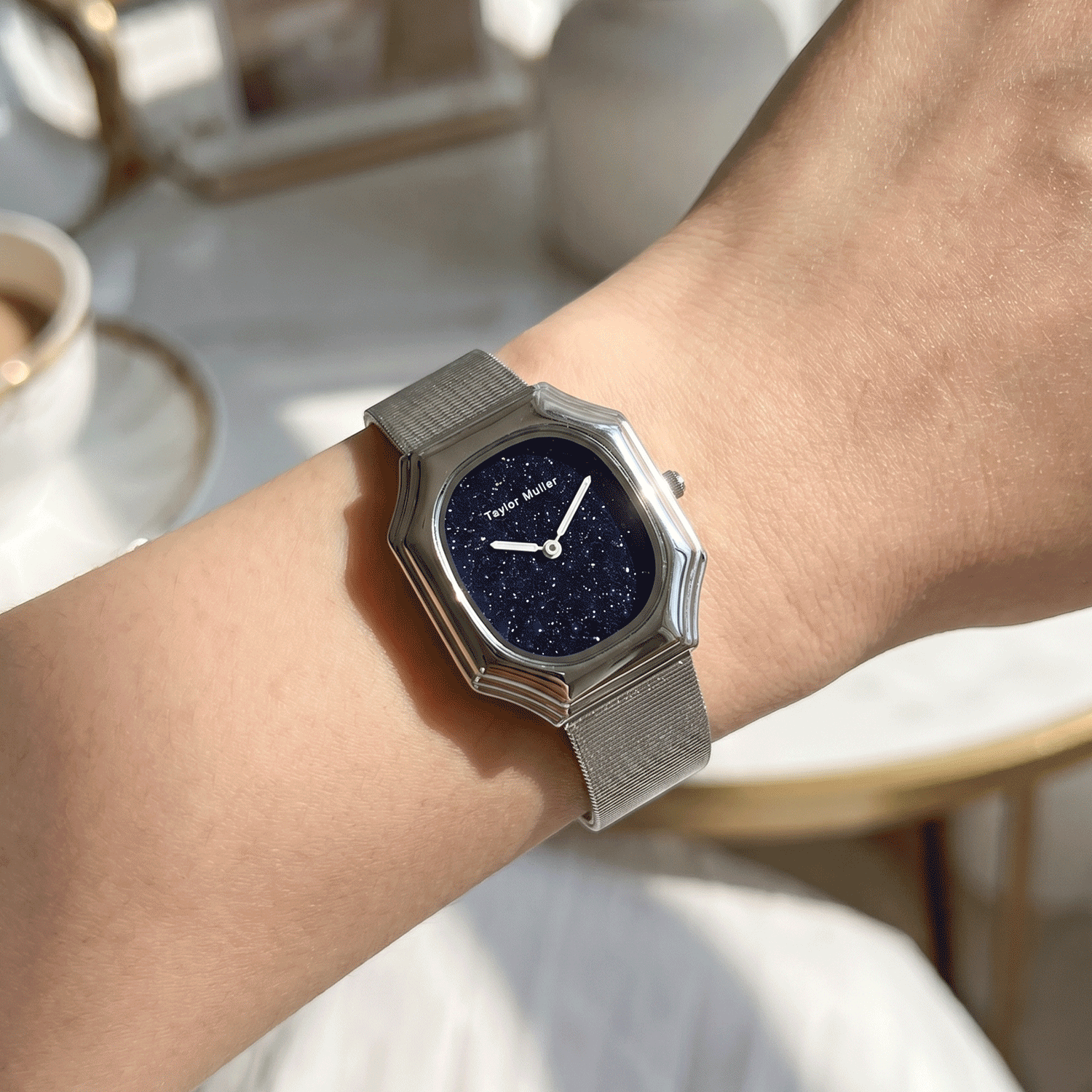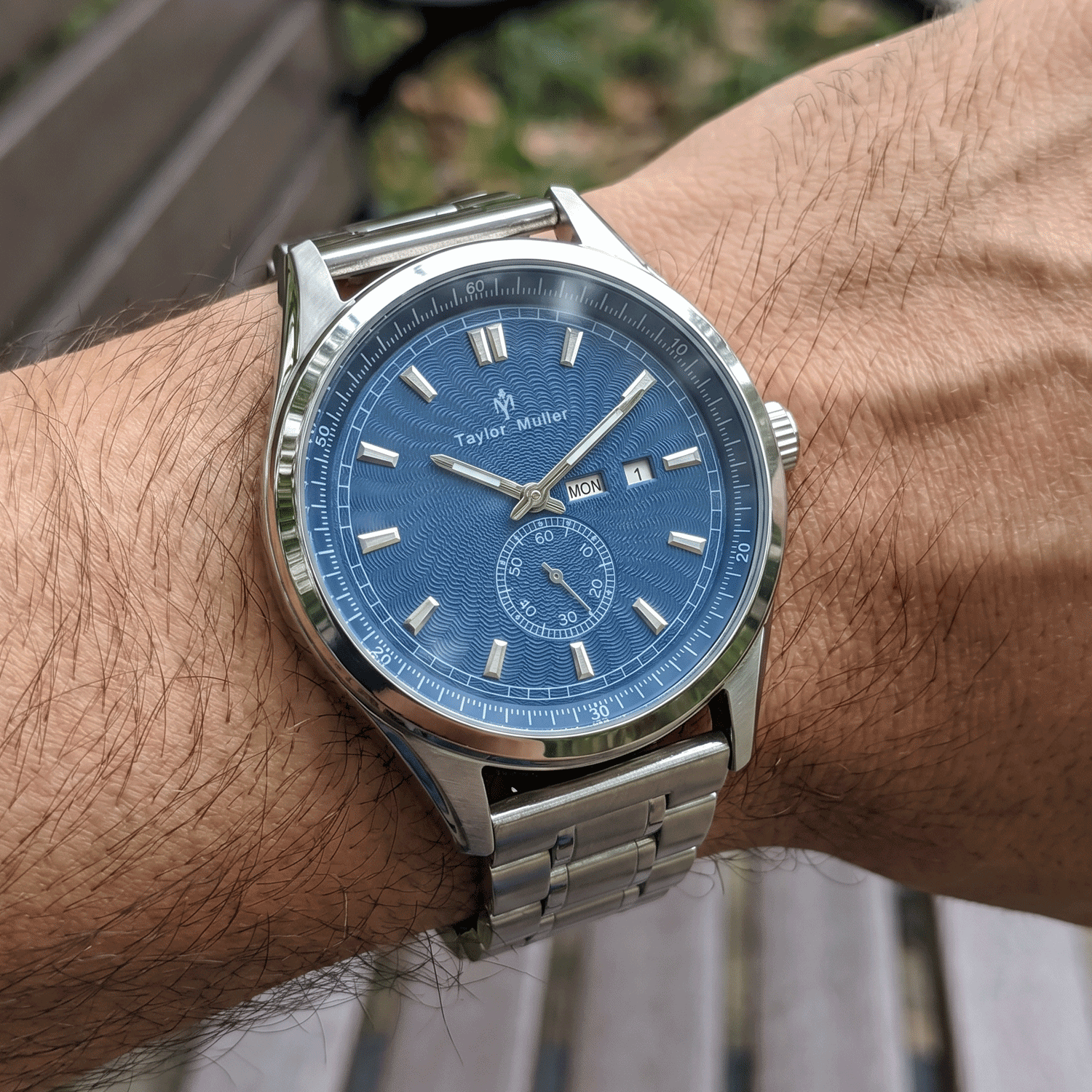
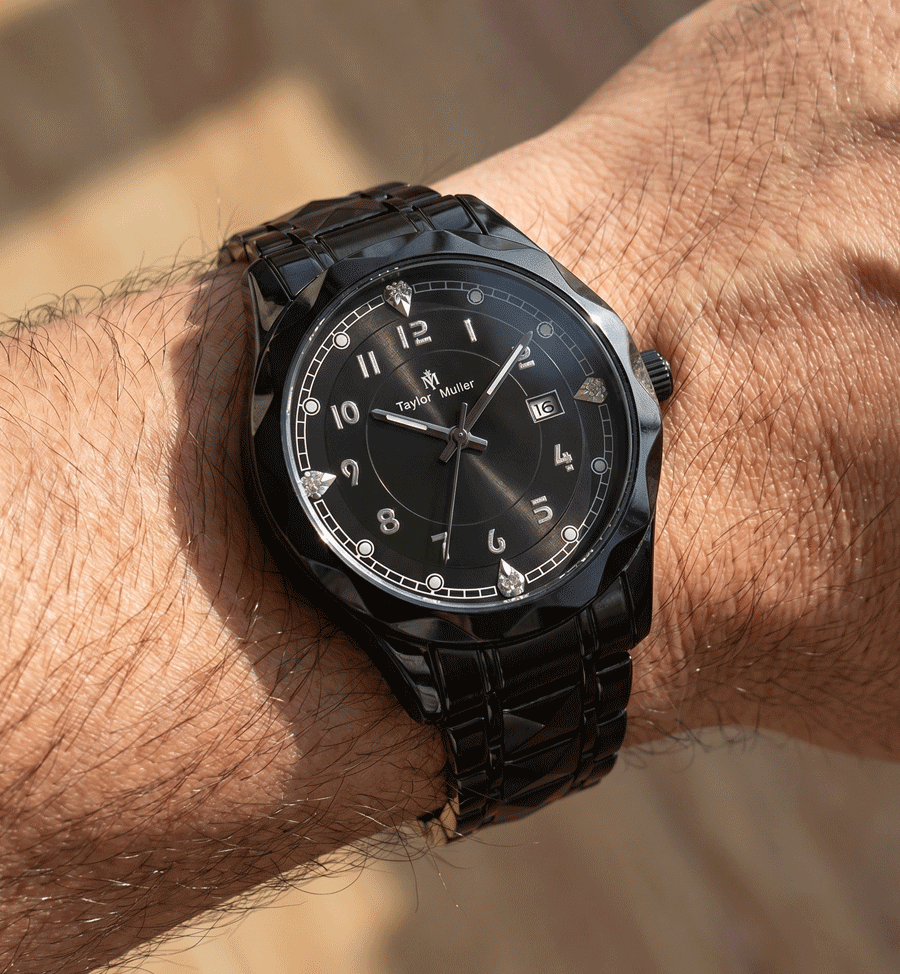
Three watches can look identical in a rendering and feel very different after a year on a wrist. The crystal is the surface every customer looks through. It changes how black a dial appears in daylight, how quickly a watch looks tired, and what happens when the case catches a door frame. The question is not simply “mineral or sapphire?” It is which surface, coating and assembly suit the price, market and use.
What each option really is
Have a quantity in mind?
Tell us the model, the colours and the quantity — we come back with the exact MOQ, target price and lead time for your build, within 24 hours on working days.
| Option | What the buyer gains | Where it can disappoint |
|---|---|---|
| Mineral glass | A clear, practical cover at the lowest material cost. It is easy to form in flat or gently domed shapes and suits value-focused watches. | It is easier to scratch than sapphire. A light mark may polish out, but a deeper scratch can remain visible and distort the dial. |
| Hard-coated mineral glass | A mineral base with a surface coating designed to improve everyday scratch resistance. It can sit between ordinary mineral glass and sapphire in look and cost. | Performance depends on the coating and how it is applied. The coated surface cannot be treated like bare glass during repair, and customers will still see marks if the coating is damaged. |
| Sapphire crystal | Strong resistance to the everyday scratches that make a watch look worn, with the clarity expected in a more premium product. | It is not unbreakable. A hard crystal can still chip or break under impact, especially around an exposed edge or a strongly domed shape. |
One source of confusion is the word “coated.” A hard coating resists scratches. An anti-reflective coating reduces reflections and makes the dial easier to see. They do different jobs, and a watch may use one, both or neither. An anti-reflective treatment can visibly improve a dark sapphire dial; a poorly applied hard coat can become the feature that fails first. Ask what is applied to each side.
The trade-off that matters: scratches, impacts and reflections
Hardness alone does not settle the choice. A surface that resists scratching may chip more easily at an edge. A crystal that survives a hard knock may show scratches sooner in normal use. Strong reflections can weaken dial contrast, while an anti-reflective layer improves legibility but adds another surface whose appearance must be controlled.
For a low-price fashion watch that is replaced often, ordinary mineral glass can be the honest choice. For a retail line that must stay presentable at a controlled price, hard-coated mineral is the useful middle. For a premium watch, sapphire is easier to defend because scratch resistance is part of what the customer expects. In a rugged watch, impact behaviour and replacement cost may matter more than a slogan about hardness.
- Check the reflected image. Look at a straight line or window in the crystal from several angles. Distortion should not make the dial look bent.
- Look along the edge. Small chips and cloudy polishing marks are easier to see at an angle than face-on.
- Check the inside surface. Dust, fibres or a fingerprint under the crystal can look like a dial defect and cannot be fixed from outside.
- Confirm the gasket. The crystal is held and sealed as an assembly; a correctly shaped crystal in a poorly seated gasket is not a finished solution.
- Separate hard coat from anti-reflective coating. Put both requirements in writing and inspect the reflection colour and surface evenness on the sample.
From our workshop
The crystal is not treated as a drop-in part. Because the case is made in our own workshop, its seat, gasket groove and retaining geometry can be checked together with the case drawing before the visual finish is approved. At assembly, the lens is inspected under a narrow beam at an oblique angle; dust and fibres show up there far more clearly than under flat overhead light. If a foreign particle is found after pressing, the crystal has to come out, the seating area is cleaned again, a fresh gasket is used and the assembly is rechecked. A late change from one crystal type to another is therefore more than one line moving on a bill of materials: thickness, dome, edge profile and gasket may all need to be confirmed again.
The main choices and the rest of the case work are covered on our OEM & ODM services page. The 29 references in the catalogue show how different crystal profiles look in finished watches, and the FAQ covers the questions buyers ask before sampling.
What to put in the specification
Write the crystal as a complete part: material, flat or domed profile, thickness, edge treatment, coating on each side, any magnifier or printed element, and the finished watch’s water-resistance requirement. If hard coat and anti-reflective treatment are both offered, ask for them to be quoted separately. That makes the sample easier to judge and prevents a later price discussion from guessing which process was included.
A sample runs 15–20 days and its fee is deducted from the bulk invoice; production is 30–45 days after approval; MOQ is 300 pcs per model, or 200 pcs when only the dial logo changes on an existing reference. Decide what the crystal has to do for the customer before deciding which name sounds more premium.
Further reading: What a watch sample tells you that a photo cannot · Hands and lume: what actually changes readability